The New Era of Fuel Delivery
Over the past decade, the food delivery industry has fundamentally changed how Americans think about convenience. With a few taps on a smartphone, meals now arrive at homes, offices, college campuses, and job sites – usually faster than it would take to pick them up in person. Companies like DoorDash and Uber Eats didn’t just deliver food; they rewired customer expectations around logistics, visibility, and on-demand service.
That same delivery model is now making its way into an industry that, until recently, seemed resistant to disruption: fuel.
Across the United States, on-demand and on-site fuel delivery is gaining traction, particularly among fleets, commercial operators, and mission-critical users. While the product being delivered is very different from a restaurant meal, the underlying mechanics are surprisingly similar – and the implications for fuel marketers, including propane professionals, are worth paying attention to.
The “Last Mile” Lesson From Food Delivery
DoorDash and Uber Eats succeeded not because restaurants changed how they cooked food, but because the platforms solved the last-mile problem:
• Matching supply (drivers) with demand (customers)
• Optimizing routing and timing
• Providing real-time visibility and communication
• Digitally handling payment, receipts, and customer service
Fuel delivery faces many of the same challenges, just with higher regulatory, safety, and compliance requirements. Instead of meals, the cargo is gasoline, diesel, or other fuels. Instead of restaurants, the supply point may be a terminal or bulk plant. Instead of a dinner table, the destination is a vehicle, generator, or other piece of equipment.
The operational logic, however, is strikingly similar.
How On-Demand Fuel Delivery Works
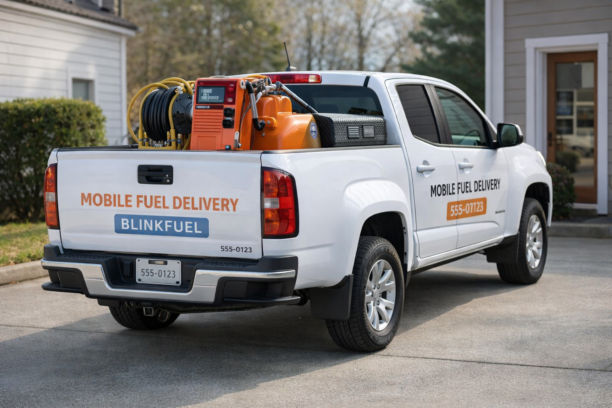
On-demand fuel delivery typically allows customers to request fuel at a specific location and time, often using a mobile or web-based platform. Trained drivers in specialized, metered trucks deliver fuel directly to parked vehicles or equipment.
This model is especially attractive where downtime is expensive or refueling logistics are inefficient, such as:
• Commercial and delivery fleets
• Construction and industrial equipment
• Backup generators
• Rental car operations
• Campuses and closed environments
Much like with the food delivery apps, customers value predictability, transparency, and convenience. Knowing when one’s fuel will arrive, how much it costs, and receiving digital records afterward is becoming an expectation rather than a luxury.
Why This Matters to the Propane Industry
At first glance, on-demand gasoline or diesel delivery may seem outside the propane world. In reality, the model shares a great deal of DNA with propane operations.
Propane marketers already understand:
• Route optimization
• Scheduled vs. on-call deliveries
• Driver training and certification
• Safety protocols and compliance
• Asset utilization and tank management
The difference is that mobile fuel delivery applies these principles in a more software-driven, customer-visible way. Food delivery platforms taught consumers to expect tracking links, ETAs, and frictionless payment. Those expectations are now carrying over into other delivery-based industries.
Fleets are Leading Adoption
Just as DoorDash and Uber Eats initially focused on urban density, on-demand fuel delivery is seeing the strongest adoption where scale and repetition exist. Fleets benefit from:
• Reduced labor spent driving to fueling stations
• Less vehicle downtime
• Centralized billing and reporting
• Scheduled fueling during off-hours
This mirrors how food delivery first gained traction with frequent users before becoming mainstream.
Regulation and Safety: Where Fuel Delivery Diverges
Obviously, fuel delivery is not food delivery. Mobile fueling is subject to strict federal, state, and local regulations, including fire codes, environmental and transportation rules, and hazardous materials standards. Vehicles, equipment, and drivers must meet requirements that far exceed those of food delivery drivers.
That said, the success of DoorDash and Uber Eats demonstrates that technology can coexist with regulation, provided the systems are designed with compliance in mind. Digital checklists, automated documentation, and real-time monitoring are increasingly part of the equation.
A Broader Shift Toward “Fuel As a Service”
Perhaps the most important takeaway of this new normal is philosophical. Food delivery normalized the idea that consumers don’t need to think about how something gets delivered – only that it shows up when and where they want it. Fuel is beginning to move in the same direction.
As fleets and commercial users focus more on uptime and efficiency, fueling becomes less about visiting a station and more about ensuring availability. This opens the door to new service models, pricing structures, and customer relationships.
For propane marketers, the rise of on-demand fuel delivery isn’t a threat – it’s a clear signal. It suggests that delivery-centric fuels, backed by strong logistics and smart technology, are well positioned for the future.
Looking Ahead
DoorDash and Uber Eats didn’t invent food; they reinvented delivery. On-demand fuel providers are attempting something similar, applying modern logistics thinking to an essential, legacy product. As energy distribution continues to evolve, the question isn’t whether customers will expect more convenience – it’s who will be best prepared to deliver it.
One example of this shift is Blink Fuel, an on-demand fuel delivery company bringing technology-driven logistics, real-time visibility, and compliance-focused operations to mobile fueling. By delivering gasoline and diesel directly to fleets, equipment, and generators, Blink Fuel reflects how “fuel as a service” is becoming a practical reality rather than a future concept. As expectations shaped by food delivery continue to influence other industries, companies like Blink Fuel illustrate how fuel delivery is being reimagined for a more on-demand, efficiency-focused world.
Learn more at BlinkFuel.com.